Why We Don't Use Time-Outs (and What We Do Instead)
One of the most common questions families ask is:
"What do you do when children misbehave?"
At Scribbles Learning Center, the answer may surprise some families - we do not use traditional time-outs. Not because we avoid setting limits, but because research and experience tell us there are more effective, respectful ways to support young children's behavior.
Why Time-Outs Don't Work for Young Children
Time-outs are often intended to give children space to "think about their behavior." But for infants, toddlers, and preschoolers, this expectation is developmentally unrealistic.
Young children:
Are still learning how to regulate emotions
Do not yet have impulse control
Often act out because they are overwhelmed, tired, frustrated, or lacking language
When a child is sent away during a moment of distress, the message they may receive is:
"I'm alone when I'm struggling."
That doesn't teach skills - it teaches isolation.
Behavior Is Communication
At Scribbles, we view behavior as a form of communication.
Hitting, yelling, refusing, or melting down usually means:
"I don't have the words yet."
"I'm overwhelmed."
"I need help regulating."
"This is hard for me."
Our job as educators is not to punish the behavior, but to teach the skill that's missing.
What We Do Instead at Scribbles Learning Center
1. Co-Regulation Comes First
Children learn to regulate themselves through relationships.
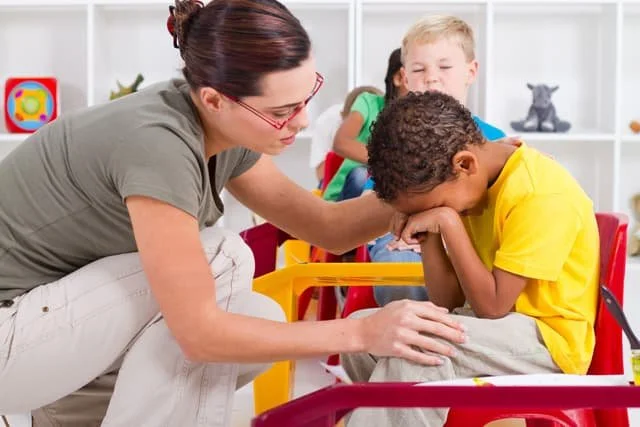
When a child is upset, a teacher may:
Get down to the child's level
Use a calm, steady voice
Acknowledge feelings ("You're really upset right now.")
Stay close until the child feels safe and calm
This models emotional regulation and builds trust.
2. Clear, Consistent Limits
Not using time-outs does not mean "anything goes."
We set firm, age-appropriate boundaries:
"I won't let you hit."
"Toys are not for throwing."
"We keep our friends safe."
Limits are clear, consistent, and enforced with calm confidence - not anger.
3. Teaching Skills in the Moment
Instead of removing a child from the situation, we teach them what to do next time:
Using words or gestures
Taking deep breaths
Asking for help
Waiting for a turn
Walking away
These skills are practiced daily, not just during challenging moments.
4. Safe Spaces for Regulation (Not Isolation)
Children may be invited to a cozy, calming space with support, not alone.
These areas help children:
Reset their bodies
Calm their nervous systems
Regain control before rejoining the group
The goal is regulation, not punishment.
5. Strong Relationships Matter
Children behave best when they feel:
Safe
Seen
Understood
Connected
Our educators prioritize relationship-building because connection is the foundation of positive behavior.
Preparing Children for Real Life
Life doesn't offer "time-out chairs." It offers emotions, challenges, and relationships.
By supporting children through moments of difficulty, we help them develop:
Emotional intelligence
Problem-solving skills
Empathy
Self-control
Confidence
These are skills that last far beyond early childhood.
What This Means for Families
Families can expect that at Scribbles:
Children are guided, not shamed
Behavior is addressed with intention and care
Teachers communicate openly with families
Each child is supported as an individual
We partner with families to ensure consistency between home and school whenever possible.
Our Philosophy in Action
At Scribbles Learning Center, we believe discipline should teach, not punish.
Children deserve guidance, understanding, and the tools they need to grow.
Because learning how to handle big feelings is just as important as learning letters and numbers.